How to Choose a Mortgage Lender in New York: Ultimate Guide


So you've got some savings, you're tired of living with seven roommates, and you're looking to settle down in the city for a while.
It could be an excellent time to start thinking about buying your place.
An exciting prospect for sure. But before you start planning your goodbye party, you've got some work to do.
In NYC's ultra-competitive real estate market, you must do homework to qualify for a mortgage.
That's right; lenders aren't throwing money like they were in the good old "aughts."”
While buyers in many other parts of the country can purchase a home with cash, in NYC, most people still need to take out loans.
Why?
The answer is simple: as we all know, homes here don't come cheap.
Here are some average sale prices in the city:
Average Sales Prices in New York City |
|
|---|---|
| Studio | $265,000 |
| 1 Bed | $429,888 |
| 2 Beds | $589,900 |
| 3 Beds | $783,000 |
| 4 Beds | $968,000 |
NYC is a seller's market, and you will need a strong lender in your corner to be a competitive buyer.
But before you meet with a mortgage broker, you'll have to do the following:
Get Your Paperwork Together
Remember all the paperwork you had to submit when you rented your place? You're going to need to gather all the same documents plus a few additional ones:
- Two most recent tax returns
- A letter from your employer stating the start date, and annual salary plus any bonuses (if you're self-employed, you'll need a letter from your accountant or attorney verifying your salary, net worth, and assets)
- As much information as possible on all checking and savings accounts, stocks and bonds, retirement plans, and any other assets
- A recent 401k or other retirement funds statement
- Information about financial obligations and outstanding debts
For more information on how to get prepared, read up on What You Need to Know Before You Buy Property.
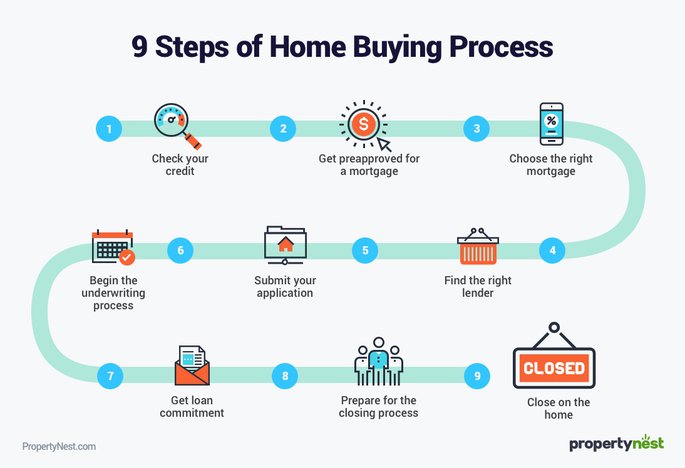
Check Your Credit
When you applied to rent your apartment, your credit report was essential. As a buyer, it's even more so.
You should check your credit report well before making an offer.
If there are any blemishes on your credit report, it will be easier to address them sooner.
It can often take over a month to contact someone at a credit reporting company, and you don't want to be in a crunch at closing time.
Read How to Improve Your Credit Score to learn more about credit scores.
Once you've completed your paperwork and worked out any kinks in your credit report, you can connect with mortgage professionals.
It's best to contact mortgage lenders at least six months before starting your search.
This will give you a realistic sense of what type of mortgage you'll qualify for, which will determine the kind of home and neighborhood you can go after.

What Credit Score Do I Need to Qualify for a Mortgage?
Generally, your FICO score should be in the "good" or "fair" range. Different sites give the score ranges different labels, but this range should start at around 680-700.
With this score, you should be able to borrow (of course, after qualifying financially) with an average interest rate.
The better your score, the better the interest rate you may qualify for.
With a score of 740 and above, you can expect to be awarded the lowest interest rates a lender offers.
What If My Credit Score Is Below 680?
Don't despair if you have a few blemishes on your record that bring you below 680.
Believe it or not. You can still qualify for a mortgage with a credit score below 580, albeit not as many financial institutions will be willing to take on the risk.
Most VA loans still require a close-to-decent score. So, that may not be an option if you are a veteran with poor credit.
FHA loans are the usual route when your FICO is less than stellar. You will probably not qualify for the best interest rates, but 580 is not out of the question for this type of government-backed loan.
Most major lending institutions offer FHA loans.
However, be aware that you cannot use this type of loan if you plan on purchasing in a New York City co-op. Furthermore, the list of condo buildings in the city accepting FHA-backed financing is also limited.
Most traditional loans will require at least a 620 to 640.
What Is a Mortgage Exactly?
A mortgage is nothing more than a specific type of term loan. But this type of loan is secured by real property.
Your mortgage becomes a lien on the title to your property. This lien has the highest priority after any state and local property tax liens in the case of foreclosure.
For any term loan, a borrower pays interest, calculated annually against the loan's outstanding balance. The monthly payment and interest rate are fixed.
Since there’s a fixed monthly payment, the portion going to pay the interest and the amount paying down the principal will change over time. At first, as the loan balance is so high, most of the payment goes towards interest.
But when the balance starts to shrink, the share of the payment going towards interest starts to decrease, and the amount going to the principal increases.
Many lenders also allow you to make larger payments per month to pay down the loan faster, but be aware that some of them may penalize you.
Understanding Interest Rates
SuppoLet'sse your bank offers a 4.15% interest rate on a 30-year fixed-rate loan.
If you have a $500,000 mortgage, your monthly payment will be $2,430.52.
In this case, you'll pay $374,985.98 in interest over the loan's lifespan.
If your loan is a 15-year, with a 3.125 interest rate and the same $500,000 mortgage, you'll be paying $3,483.05 monthly.
While this is $1,052.53 higher than In the case of a 30-year mortgage, the total interest you will pay over the 15 years is $126,948.41 - $250,000 less than that of the 30-year mortgage,
The 30-year Mortgage
In a 30-year loan, the balance will decrease more slowly, as the buyer is essentially "renting" the same amount twice as long as the 15-year mortgage.
The gap between the two mortgages is most evident when considering interest rates.
For example, if the interest rate is 4%, the borrower will pay over 2x more interest to borrow the same amount over 30 years, compared to a 15-year loan scenario.
So, the main advantage of a 30-year mortgage is the low monthly payment, the most popular type of loan for cash-strapped buyers.
The 15-year mortgage
30-year loans typically come with a higher interest rate than a 15-year mortgage.
This is because it's riskier for a bank to give out a 30-year loan. The longer-term loans also cost them more.
Since 15-year loans are less risky for banks, they will typically have lower interest rates. This can add up to more savings over the long term.
Remember that your monthly premium will be higher since you are calculating the same mortgage amount as a 30-year but trying to pay it off in 15.
Ultimately, you will save money over the life of this loan with lower interest rates.
Jumbo Loans
In most areas of the country, if you need a mortgage above $484,350, you'll have to go with a jumbo loan.
Generally, you'll need a perfect credit score of about 700 or above, reasonable cash reserves, a debt-to-income ratio of about 45%, and a high-earner.
New York City is considered a high-demand, high-cost market, so the threshold is higher at $726,525.
Traditionally, lenders require higher down payments, better cash reserves, and good credit scores and will slap on a higher interest rate for jumbo loans.
However, it's not unusual to find institutions that offer comparable interest rates and down payments to more conventional or what'sconforming loans.
Adjustable-Rate Mortgage (ARM) vs. Fixed-Rate
A conventional fixed-rate mortgage will have the same interest rate for the life of the loan.
As mentioned above, the initial payment period will see you making a minor dent in your principal with a good chunk of interest.
However, as you eventually pay more into the principal, your monthly payments chipping away at the principal will compound.
An adjustable-rate mortgage is as it sounds. The rate is not fixed for the life of the loan. There is an initial period where the rate is fixed for a set number of years (anywhere from 3-10 years).
After this introductory period, however, the rate will fluctuate with market interest rates.
This is generally seen as a riskier option. It's what got the housing market in trouble in 2008 when ARM was coupled with predatory lending.
However, an ARM may make sense if you don't plan on owning the home for long. You can predict interest rates lowering in the future, plan on paying down the loan quickly, or plan to refinance.
Remember that these are risky options as you may not be able to get good returns on selling your home in a few years, interest rates can go up, and your financial situation can change.
Consider it carefully before being seduced by a low introductory rate. There are a few different options with ARMs as well.
What is Private Mortgage Insurance (PMI)?
If you put down less than 20% on your purchase, your lender may require you to get Private Mortgage Insurance or PMI.
This insurance you must buy into protects your lender should you default on your loan.
Because you are putting down less, the lender sees your loan as a higher risk.
This is another situation where credit will be factored in. With excellent credit, you can expect a low insurance premium.
The lower your credit, the higher the premium.
However, it's worth remembering that some banks may offer special programs where you can avoid getting PMI even with as little down as 3%. So, you'll need to do a little shopping around.
What Are Mortgage Points and How Can They Help Me?
Points are also called "discount points".
These points are percentages that you pay at closing to reduce your monthly payments.
For example, 1 point equals 1% of your mortgage or $1,000 for every $100,000 of your loan.
Going this route is the most effective if you are going with a fixed-rate mortgage, although not entirely out of the question with even an ARM.
Deciding if mortgage points will work for you will require some math.
If you're working with a mortgage broker, most account managers will be able to help you make these calculations.
When deciding to purchase points, some factors to consider are your ability to pay additional at closing, how much you are putting down, if your rate is adjustable, and how long you plan on owning your home.
How Do I Choose a Lender for My Mortgage?
Your first inclination might be to go immediately with the financial institution where you usually do your banking.
After all, they know you best and might offer you reasonable rates.
While you may be offered a great deal, this is not always true.
Different lenders have different reputations for each of their financial services and products.
Even if the bank is reputable, it may not be the best lender.
Furthermore, lenders can vary considerably in rates, closing costs, credits, and grants they can offer you, as well as their customer service.
Customer Service Should Be Just as Important as Getting Good Rates
When account managers and underwriters drop the ball in communication or can't or refuse to answer your questions, it can break the entire mortgage underwriting process.
This could result in catastrophe with your home purchase--you may not be able to close or lose the deal entirely!
This is why considering the level of customer service is one of the most paramount aspects in choosing a lender.
Size doesn't matter with these lenders. Some smaller lenders have excellent customer service, as with larger banks.
However, small credit unions or banks can also be complete duds and license local banks.
The best way is to ask around friends and family who have bought and see if they had a good or bad experience with their lender(s).
Consider Working with a Mortgage Broker
There are two options you have when looking to work with a lender.
You can go directly to a financial institution offering mortgage products or work with a mortgage broker who can help you get rates from several lenders.
While you can be pleased working with a bank or lender directly (given they offer excellent customer service), a mortgage broker's job is to be your personal account manager.
Their sole job is to find the product from the banks they work with that best fits your purchase needs.
A mortgage broker also guides you from start to finish, so there is no breakdown in communication.
NYC Buildings and Lenders
In NYC, lenders will look at the types of buildings you're considering.
You want to focus on buildings that banks see as stable investments.
Banks will be looking at the reserves of a building. Generally, a bank doesn't want to see that more than 15% of the units are rented.
This is because renters are seen as causing more wear and tear on a building, decreasing its value.
This is an issue on the rise in New York City, where so many properties are being purchased as investment units.
In the case of such buildings, lenders in NYC typically will not give loans for more than 50% of the appraised value of an apartment.
Similarly, banks don't want to see more than 20% of a building's space used for commercial purposes.
How Purchasing a Co-op Can Affect the Mortgage
Co-ops constitute roughly 70% of the housing stock in Manhattan.
Meanwhile, with a condo, you buy a dedicated property, and in a co-op, you purchase building shares.
Co-ops have a rigorous vetting process. Sometimes, co-ops may not even allow mortgages, or they'll allow only a certain percentage of the purchase to be financed.
Co-op boards typically want 20% down and enough cash on hand to pay for two years of mortgage and maintenance.
If you're looking on the Upper East Side, especially west of Lexington Avenue, co-ops are even more stringent - they may want all cash and ask to see even heftier reserves.
What to Know about Condos and Lenders
Condos in NYC have less stringent guidelines when it comes to financing.
But, as mentioned above, it's essential to make sure that the characteristics of the building will be appealing to your lender.
As noted, banks will be reluctant to lend if more than half of the condo units are investment properties.
To learn more about co-ops and condos, read up on our article about co-ops and condos and the differences.
With all this knowledge in your back pocket, you should be ready to throw your hat in the ring of potential NYC buyers.
Your next important step is knowing how to make an offer.
Once you have a mortgage procured, ensure you have a trusted agent and team of professionals. You don't want to be flying solo when navigating today's housing market in NYC.
Search for Home Sales in NYC
Search for your next home based on a credit
score, price,
neighborhood & more.
- Selection Criteria: Companies are chosen based on customer service, affordability, and coverage diversity.
- Data Collection: Data is amassed from credible sources, customer surveys, and industry reports.
- Analysis: A robust analysis, employing a scoring system, is conducted to rank the companies.
- Updating: This page is regularly updated to offer the most current information.
- Editorial Integrity: We uphold a transparent editorial process and disclose any affiliations.
- User Engagement: User feedback is integral and factored into our evaluations.
- Accessibility and Usability: Our page is crafted for ease of use, mobile optimization, and wide accessibility.
- Editorial Independence: Our editors and writers work independently, free from influence by advertisers.
- Source Disclosure: All data sources are disclosed and credited.
- Conflict of Interest: Any potential conflict of interest is disclosed to maintain integrity.
- Reviewer Qualifications: The qualifications of reviewers and contributors are provided.
- Update Frequency: The frequency of updates and revisions is clearly stated.
- Correction Policy: A clear policy for correcting errors is in place to uphold accuracy and trust.